Skip to product information
1 of 3

Lionel Brooks

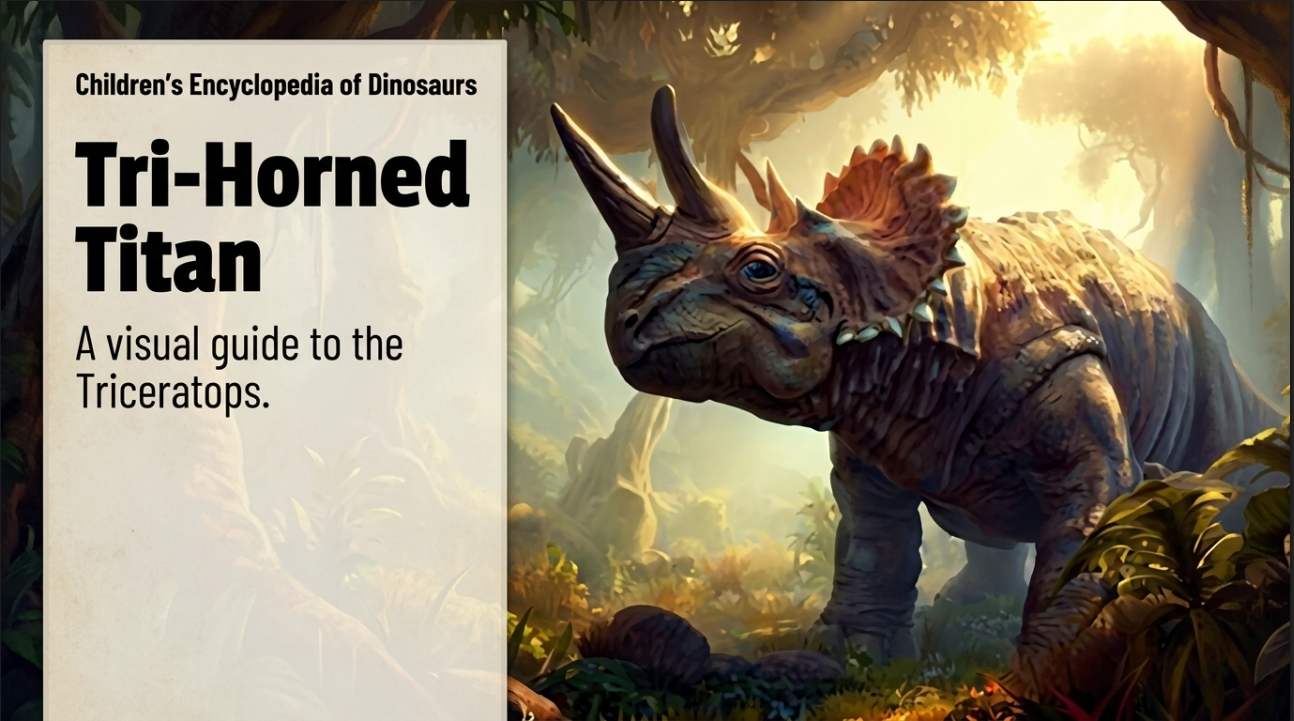
Children’s Encyclopedia of Dinosaurs_Triceratops

Children’s Encyclopedia of Dinosaurs_Triceratops

Regular price $4.99 USD
Regular price $1.99 USD Sale price $4.99 USD
Sale Sold out
Shipping calculated at checkout.

Give Your Child the Gift of Learning with This Amazing Triceratops Adventure Ebook!

Introducing Children’s Encyclopedia of Dinosaurs – Triceratops — a powerful educational ebook that takes kids back to the Late Cretaceous to meet Triceratops, the famous “three-horned titan” that looked a bit like a giant, armored rhinoceros. This ebook is perfect to spark curiosity, build science vocabulary, and help children understand how horns, a big frill, and a sturdy body turned a plant-eating dinosaur into a tank-like giant able to face fierce predators.

This exclusive ebook includes:

✅ Main Ebook: Children’s Encyclopedia of Dinosaurs_Triceratops
A kid-friendly encyclopedia entry that explains what makes Triceratops special: it was a large, four-legged herbivorous dinosaur with three sharp horns on its face — two long horns above its eyes and one shorter horn on its nose — and a huge bony neck frill that surrounded the back of its head like a shield. Children discover that Triceratops lived about 68–66 million years ago during the Late Cretaceous period, mainly in what is now western North America, and that its name means “three-horned face” in Greek. The ebook introduces simple ideas such as “ceratopsian,” “herbivore,” and “frill,” and shows how Triceratops could reach around 8–9 meters (about 26–30 feet) in length and weigh several tons, making it one of the largest horned dinosaurs. It also explains how Triceratops used its beak-like mouth and rows of shearing teeth to clip and chew tough plants, including palm fronds and other fibrous vegetation, and how its horns and frill helped protect it from predators like Tyrannosaurus rex and may also have been used to impress other Triceratops or fight rivals.

Children learn that the skull and frill of Triceratops were among the largest of any land animal, and that many fossils found in formations like Hell Creek show that Triceratops was one of the last dinosaurs to roam the Earth before the mass extinction at the end of the Cretaceous. The ebook describes how Triceratops probably moved in groups, used its horns both for defense and display, and may have lived in rich, forested and open habitats filled with other plant-eaters and meat-eaters.

✅ Poster Infographic: Triceratops__The_Three-Horned_Titan
A colorful infographic page that visually presents the most important facts about Triceratops: length, weight, horn arrangement, frill size, habitat, and plant-eating diet. The infographic uses diagrams and short captions to help children quickly remember that Triceratops had two long brow horns and a shorter nose horn, a massive frill at the back of its head, and a strong, tank-like body supported by four sturdy legs. It highlights fun facts such as how its name literally means “three-horned face,” how its frill may have helped protect its neck and also made it look impressive to other Triceratops, and how it lived alongside famous predators like Tyrannosaurus rex in the very last age of the dinosaurs. This turns complex information into a simple, memorable visual guide that kids can revisit whenever they want a quick “three-horned titan at a glance” reference.

✅ Parent Presentation: Tri-Horned_Titan
A structured parent presentation designed for families, teachers, and curious young learners that works like a mini guide to Triceratops as a “tri-horned titan.” It organizes key information on anatomy, horns and frill, fossils, habitat, and behavior into clear sections that make discussion, note-taking, projects, and school reports easier. The presentation can include a simple timeline showing when Triceratops lived, a map of where its fossils have been found, comparison boxes that contrast Triceratops with other horned dinosaurs and with modern animals like rhinoceroses, and question prompts that encourage children to think about how horns and armor help animals survive and communicate. This helps adults and learners connect the main ebook to broader themes about dinosaur defenses, social behavior, and life in Late Cretaceous ecosystems, just before the dinosaurs disappeared.

Why this ebook is perfect for your child:

  • Designed for children ages 4–10, with clear explanations and bold visuals of Triceratops standing firm on four legs, showing off its three horns and large frill, and facing threats with a tank-like body.

  • Combines narrative reading, infographic learning, and parent-friendly presentation material for maximum impact in classwork, homework, or home learning.

  • Encourages curiosity about horned dinosaurs, tough plant diets, predator–prey relationships, and how scientists use skulls, horns, and teeth to understand ancient animals.

  • Helps children build awareness about herbivores, armor and horns as defenses, and the way Earth’s last dinosaurs included giants that relied on strength and protection rather than speed or sharp claws.

By choosing Children’s Encyclopedia of Dinosaurs – Triceratops, you give your child a strong learning experience that connects storytelling, real dinosaur science, and Earth history, turning every page into a “three-horned titan” adventure in the world of prehistoric plains and forests.

“I believe books have the power to enrich your knowledge, ignite your curiosity, and motivate you to learn more.” — Lionel Brooks

Perfect for children ages 4–10. Great for school projects, dinosaur reports, or weekend reading for young fans of horned and armored giants!
Get your Triceratops ebook today — instant download included!

View full details